
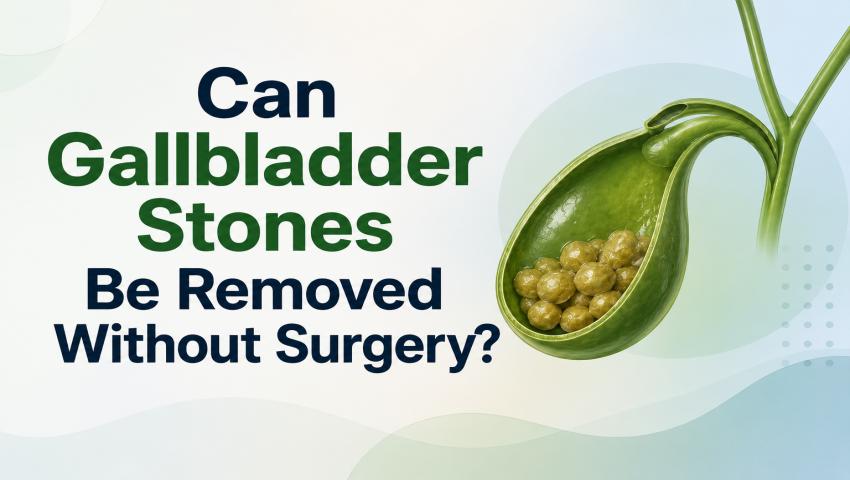
The short answer is — sometimes, but not always. Most cases of gallstones, medically known as Cholelithiasis, do require surgical intervention for permanent relief. While there are some non-surgical methods available, they work only in very specific and limited situations. Gallbladder calculi, if left untreated or poorly managed, can lead to serious complications. Understanding your options clearly is the first step towards making the right decision for your health.
What Are Gallbladder Stones?
Gallbladder stones are hard deposits that form inside the gallbladder — a small, pear-shaped organ located just below the liver. The gallbladder stores bile, a digestive fluid that helps break down fats. When the components of bile become imbalanced, they can crystallise and form stones ranging from the size of a grain of sand to as large as a golf ball.
These stones are extremely common in India, affecting millions of people across all age groups. Many people live with gallstones without knowing it, as they may not cause any symptoms in the early stages.
How Do Gallbladder Stones Form?
Gallstones form when there is an imbalance in the substances that make up bile. Here are the main reasons they develop:
- Excess cholesterol in bile — When the liver releases more cholesterol than bile can dissolve, it crystallises into stones
- Excess bilirubin — Conditions like liver cirrhosis or blood disorders can cause too much bilirubin, leading to pigment stones
- Incomplete emptying of the gallbladder — If the gallbladder does not empty fully or frequently enough, bile becomes concentrated and stones form
- Obesity and poor diet — High-fat, low-fibre diets significantly increase the risk
- Rapid weight loss — Crash dieting causes the liver to release extra cholesterol into bile
- Family history — Genetics play a role in who is more likely to develop Cholelithiasis
Non-Surgical Options for Gallstone Removal:
Many patients search for gall bladder stone treatment without surgery, and it is a fair concern. Here is what is currently available and what you should know:
1. Ursodeoxycholic Acid (UDCA) Tablets: This is an oral medication that can slowly dissolve small cholesterol-based gallstones. However, it works only if:
- The stones are small (less than 5 mm)
- The stones are made purely of cholesterol
- The gallbladder is still functioning well
- The patient has no severe symptoms
Even then, treatment can take 6 to 24 months, and stones can return after stopping the medication. This is not a permanent solution for most patients.
2. Extracorporeal Shock Wave Lithotripsy (ESWL): This method uses sound waves to break gallbladder calculi into smaller fragments. It is rarely used today because:
- It works only for a single small stone
- Fragments can still cause blockages
- It does not prevent new stones from forming
- It is not widely available in India
3. Contact Dissolution Therapy: A solvent is injected directly into the gallbladder to dissolve stones. This is an experimental procedure, not widely practised, and carries significant risks.
The honest truth about removing gallstones without surgery: Most of these non-surgical options are suitable for only a very small percentage of patients. They offer temporary relief and not a permanent cure. If your stones are large, multiple, causing symptoms, or blocking ducts, surgery is the safest and most effective option.
When Is Surgery Necessary?
Surgery becomes necessary when gallstones are causing problems that cannot be managed with medication or lifestyle changes. You need to consult a specialist immediately if you experience:
- Sudden, severe pain in the upper right abdomen or centre of the abdomen
- Pain that spreads to the right shoulder or back
- Nausea, vomiting, and fever with chills
- Yellowing of the skin or eyes (jaundice)
- Recurrent episodes of abdominal pain after eating
- Inflammation of the gallbladder (Cholecystitis)
- Blockage of the bile duct
In these situations, gall bladder calculi treatment through surgery is the recommended and definitive treatment. The most common and preferred procedure today is Laparoscopic Cholecystectomy — a minimally invasive surgery where the gallbladder is removed through small keyhole incisions using a camera. Recovery is quick, pain is minimal, and patients can usually go home within one to two days.
At Sai Vedant Multi Speciality Hospital in Pune, Dr. Lalit Banswal — a leading Best GI Surgeon and Best Robotic Surgeon — performs advanced laparoscopic and robotic gallbladder removal surgeries with excellent outcomes and faster recovery times.
What Size of Gallbladder Stones Need Surgery?
Size matters when deciding treatment. Here is a simple guide:
It is not just about size though. Even a small stone can cause a complete bile duct blockage and become a medical emergency. Multiple stones, regardless of size, usually require Gallstone Removal Surgery in Pune for permanent resolution.
Conclusion:
Can gallbladder stones be removed without surgery? In rare and very specific cases — yes. But for the vast majority of patients, especially those with symptoms, large stones, or multiple calculi, surgery remains the most reliable, safe, and permanent solution.
Do not delay seeking medical advice if you are experiencing symptoms. Early diagnosis and timely treatment can prevent serious complications. If you are looking for expert gallstone treatment in Pune, consult Dr. Lalit Banswal at Sai Vedant Multi Speciality Hospital for a thorough evaluation and a personalised treatment plan that is right for you.
