
A diagnosis of prostate cancer can be a life-changing moment for any man and his family. However, with modern medical advancements in 2026, it is no longer a disease that always requires large incisions or long hospital stays. If you are looking for a Cancer Specialist in Pune, you have access to some of the most advanced medical technology in the world. Dr. Lalit Banswal, a highly respected Robotic Surgeon with over 15 years of experience, provides world-class care for Genitourinary Cancer at Sai Vedant Multi-Speciality Hospital. This facility is widely recognized as the best cancer hospital in Pune, offering precision-based treatments that focus on both curing the cancer and preserving the patient’s quality of life.
What Is Prostate Cancer?
Prostate cancer is a type of cancer that develops in the prostate gland—a small walnut-shaped gland in men that produces seminal fluid. It is one of the most common types of cancer in men globally. While some prostate cancers grow slowly and may need minimal or even no treatment, others are aggressive and can spread quickly.
Early detection is the key to a successful cure of cancer. When the cancer is confined to the prostate gland, a prostate operation or prostate removal is often the most effective way to eliminate the disease entirely.
What Is Robotic Prostate Cancer Surgery?
In medical terms, the surgical removal of the prostate is called a prostatectomy. To prostatectomy define, it is a procedure to remove part or all of the prostate gland. When the entire gland and some surrounding tissue are removed due to cancer, it is called a radical prostatectomy.
Today, the “gold standard” for this procedure is Robotic Prostatectomy, also known as RARP surgery (Robot-Assisted Radical Prostatectomy).
- RARP Surgery: This is a minimally invasive prostate cancer surgery where a surgeon uses a high-tech robotic system to perform the operation through tiny incisions.
- Meaning of Prostatectomy: While “prostatectomy” generally means prostate removal, in the context of cancer, it almost always refers to a radical robotic prostatectomy.
When Is Robotic Surgery Recommended for Prostate Cancer?
A Robotic onco surgeon typically recommends surgery when the cancer is “localized,” meaning it hasn’t spread beyond the prostate gland. It is a primary treatment choice for:
- Men with a life expectancy of 10 years or more.
- Patients with intermediate or high-risk localized cancer.
- Cases where the goal is complete prostate removal surgery to ensure the cancer does not return.
Who Is the Right Candidate for Robotic Surgery?
Most men who are candidates for a traditional open prostatectomy are also candidates for robotic surgery for prostate cancer. The ideal candidate is someone who:
- Has localized prostate cancer (Stage T1 or T2).
- Is in relatively good overall health to undergo anesthesia.
- Wishes to prioritize the preservation of urinary control and sexual function.
How Robotic Prostate Surgery Is Performed?
Understanding how Dr. Lalit Banswal performs this complex prostate operation can help ease any anxiety. The procedure is a marvel of modern engineering and surgical skill.
1. The Setup:
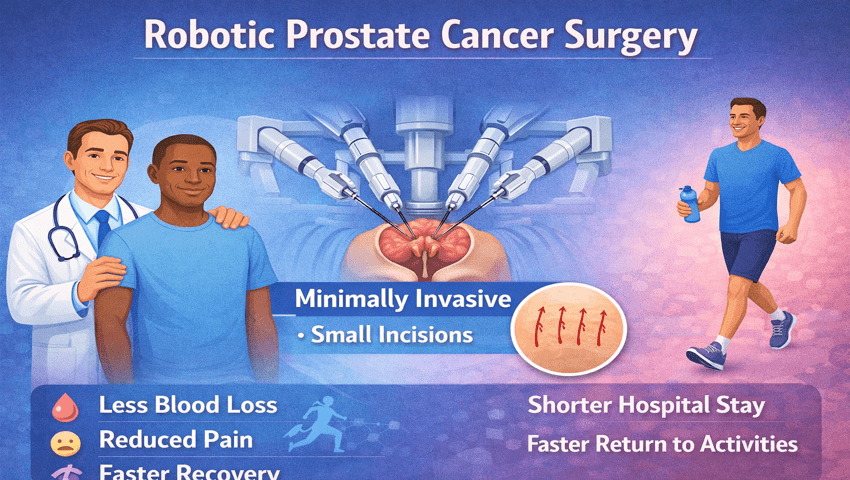
Unlike an open prostatectomy that requires a large 6-inch incision, the robotic approach uses 5 to 6 tiny “keyhole” incisions (about 1-2 cm each) in the abdomen.
2. The Robotic System:
The surgeon does not stand over the patient. Instead, they sit at a special console a few feet away. This console provides a 3D, high-definition, magnified view of the inside of the patient’s body.
3. Precision Instruments:
The robotic arms hold specialized instruments that have a greater range of motion than the human wrist. These instruments can rotate $360^{\circ}$ with zero tremors, allowing for extreme precision near delicate nerves and blood vessels.
4. The Procedure Steps:
- Gaining Access: The abdomen is inflated with $CO_2$ gas to create space for the surgeon to work.
- Dissection: The surgeon carefully separates the prostate from the bladder and the urethra.
- Nerve Sparing: This is the most critical part. The surgeon identifies the “neurovascular bundles” that control erections and carefully moves them aside before removing the prostate.
- Removal: The prostate and seminal vesicles are placed in a small bag and removed through one of the tiny incisions.
- Reconstruction: The bladder is then reattached to the urethra (this is called anastomosis) over a temporary catheter.
Benefits of Robotic Prostate Cancer Surgery:
Choosing robotic surgery for prostate offers significant advantages over traditional lap radical prostatectomy or open surgery.
- Superior Precision: The 10x magnification allows the Best Oncosurgeon in Pune to see the tiny nerves that control sexual function and urinary continence much more clearly.
- Minimal Blood Loss: Because the incisions are small and the visibility is high, there is very little bleeding. Most patients do not require blood transfusions.
- Less Pain: Smaller incisions mean significantly less post-operative pain and a reduced need for heavy painkillers.
- Shorter Hospital Stay: Most patients go home within 24 to 48 hours after a radical robotic prostatectomy.
- Faster Recovery: Patients typically return to their normal daily activities and work much sooner than with traditional surgery.
- Lower Risk of Infection: Smaller wounds and less exposure of internal tissues lead to fewer complications.
Risks and Possible Complications:
Every surgery has risks, and it is important to understand the potential side effects of prostate removal.
- Urinary Incontinence: This is the inability to control urine. Most men experience some leaking immediately after the catheter is removed, but this usually improves over 3 to 6 months with Kegel exercises.
- Erectile Dysfunction: Because the nerves controlling erections sit right next to the prostate, they can be affected. Recovery of sexual function can take 6 to 18 months.
- Lymphedema: If lymph nodes are removed during the prostatectomy, some swelling in the legs may occur.
Recovery After Robotic Prostate Surgery:
The recovery period is where the robotic approach truly shines. Here is a general timeline of what to expect after your prostate removal surgery:
The First 24 Hours:
- You will be encouraged to sit up and even walk a few steps. Movement is vital to prevent blood clots.
- You will have a urinary catheter in place to allow the new connection between the bladder and urethra to heal.
Week 1: At Home:
- You can perform light activities like walking around the house.
- Avoid lifting anything heavier than 5 kg.
- The catheter is usually removed in the doctor’s office 7 to 10 days after surgery.
Weeks 2 – 6: Returning to Normal
- You can start driving again once the catheter is out and you are off pain medication.
- Most men return to desk jobs by week 2 or 3.
- By week 6, you can usually resume more strenuous exercise and heavy lifting.
Life After Surgery: Urinary Control and Sexual Health
The two biggest concerns for men undergoing a prostate operation are “Will I be able to control my bladder?” and “Will I be able to have sex?”
- Continence: With the precision of a robotic oncologic surgeon, the muscles that control urine (sphincters) are better preserved. Most men achieve full control within a few months.
- Potency: If a “nerve-sparing” procedure is performed, the chances of recovering erections are much higher. Your doctor may prescribe medications (like Sildenafil) shortly after surgery to “rehab” the nerves and promote blood flow.
Success Rate of Robotic Prostate Cancer Surgery:
In the hands of an expert, the success rate for radical robotic prostatectomy is excellent.
- Cancer Control: In early-stage cases, the 10-year survival rate is nearly 95\% – 99\%.
- Negative Margins: Robotic surgery has a high rate of “negative margins,” meaning no cancer cells were found at the edge of the removed tissue.
Why Choose Dr. Lalit Banswal for Robotic Prostate Cancer Surgery in Pune?
When it comes to Genitourinary Cancer, the experience of the surgeon is the single most important factor for a good outcome. Dr. Lalit Banswal is widely considered the best oncosurgeon in Pune for several reasons:
- High Volume Experience: Having performed thousands of cancer surgeries, he has the “muscle memory” and technical skill required for robotic precision.
- Advanced Technology: Operating at Sai Vedant Multi Speciality Hospital, he utilizes the latest robotic surgical platforms available in 2026.
- Comprehensive Care: From the initial diagnosis to post-operative rehabilitation, the focus is on a holistic recovery.
- Patient Trust: He is known for his simple, honest communication, helping patients feel confident in their treatment path.
Conclusion:
Robotic prostate cancer surgery represents the pinnacle of surgical care. It offers the best chance of curing cancer while minimizing the impact on your daily life. By choosing a specialized Robotic onco surgeon and a facility like Sai Vedant Multi Speciality Hospital, you are choosing the path to a faster, safer, and more effective recovery.
Frequently Asked Questions (FAQ's):
The procedure usually takes between 2 to 4 hours, depending on the complexity of the case and whether lymph nodes need to be removed.
While the technology itself is more costly, the overall expense is often balanced by a shorter hospital stay, fewer complications, and a faster return to work.
Robotic surgery is primarily used for localized cancer. For advanced stages, it may be used as part of a “multimodal” treatment plan alongside hormone therapy or radiation.
While unrelated to the prostate, general cancer screening is vital. For most men, a screening colonoscopy should be done every 10 years starting at age 45, though your doctor may recommend more frequent checks if you have risk factors.
No. You will have 5 or 6 tiny scars, each about the size of a fingernail, which usually fade and become barely noticeable over time.
